In the previous article, Redeeming ANA Miles Under the New Chart, we introduced some basic redemption ideas, such as how to book a round-trip award with an open jaw and a stopover. ANA miles are still very useful for round-trip travel between China and the U.S.: the mileage cost is low, and the program allows a generous two open jaws plus one stopover. Today we’ll continue exploring ANA mileage redemptions and see what other pleasant surprises they can offer.
Contents [Hide]
- 1 Tip 7. Can tickets that cannot be booked online with ANA be ticketed by phone?
- 2 Tip 8. Can ANA miles book a round trip and throw in a domestic award ticket?
- 3 Tip 9. Does ANA charge fuel surcharges on award tickets?
- 4 Tip 10. What is the award chart for ANA-operated flights?
- 5 Tip 11. Can ANA book round-the-world tickets?
- 6 ANA
Tip 7. Can tickets that cannot be booked online with ANA be ticketed by phone?
Based on reader testing, awards that do not show up for booking on the website can sometimes be issued over the phone, including ANA-operated flights. The award space ANA agents can see may differ from what shows up through UA and AC. (As mentioned in the previous post, readers tested Air China award seats that were not visible through UA and AC and found that they were not bookable. To be cautious, OneMoreDay removed that part from the previous article.)
My suggestion is this: first search on the ANA website. If you find the award you want and can book it there, just go ahead and do that—it is the easiest option. If not, use the UA and AC search engines instead (for UA award searching, see this article). If both programs show the same award, that usually means it should be bookable, and at that point you can call ANA to make the reservation. Give the agent the dates and airports first and see what award options ANA offers. Whether they match what you found is very much a YMMV situation, and you might even get a pleasant surprise :). If you have a good conversation with the agent, you may even get the phone booking fee waived—there are online data points for that.
Tip 8. Can ANA miles book a round trip and throw in a domestic award ticket?
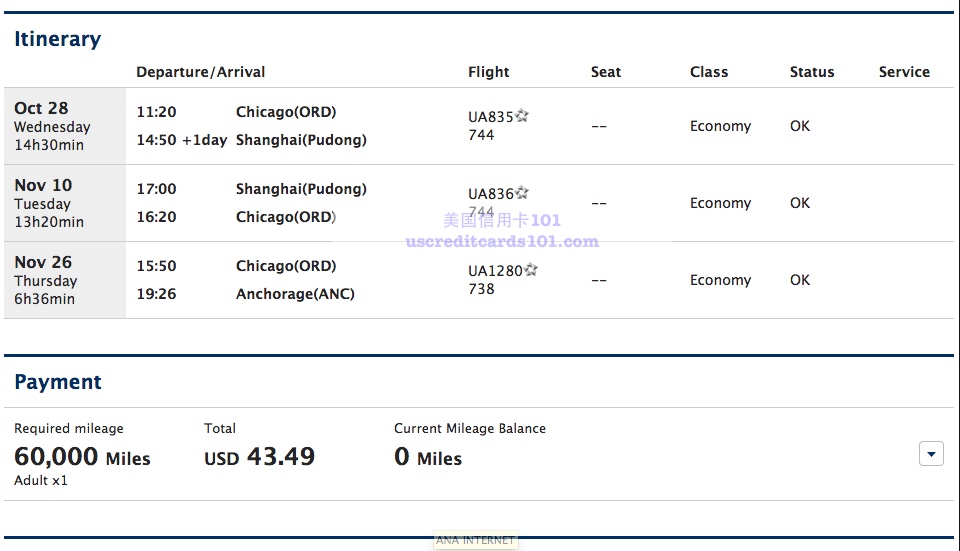
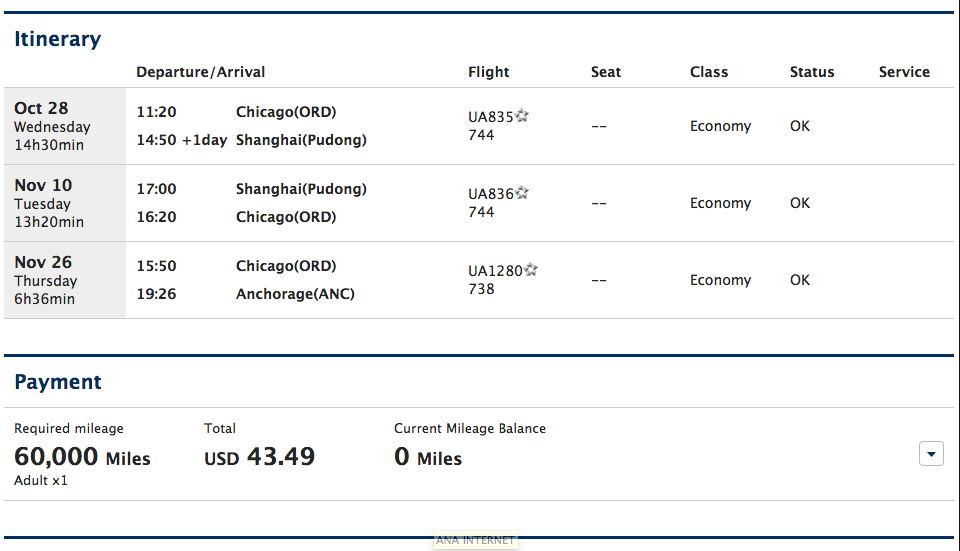
Because ANA’s stopover policy is very generous, you can also create a Free Oneway similar to what people used to do with UA miles—in other words, book one round trip and add an extra one-way segment for free:

The example above is a Chicago–Shanghai round trip plus a one-way ticket from Chicago to Anchorage to see the Northern Lights:

But this seems to be about as far as you can go. Mexico also works, but Hawaii does not, because a round trip from Shanghai to Hawaii costs 55,000 miles, while a round trip from Shanghai to Chicago costs 60,000 miles. ANA does not allow a connection via a city in a “higher zone,” so Shanghai–Hawaii cannot connect via Chicago, which requires a higher mileage level.
So after seeing the Northern Lights, how do you get back from ANC to Chicago? In fact, this Free Oneway can also be placed as the first segment and connected to the next round trip. For example, we could ticket the following itinerary:


So after returning from ANC to Chicago, you can add a round trip to Europe the following spring (and still have an open jaw at the destination).
Put together, these two tickets become one round trip back home + one round trip to Alaska + one round trip to Europe, for a total of 60,000+55,000=115,000 miles and about $150 in taxes. Compared with not using a Free Oneway, this saves 30,000 miles.
For comparison, if you used UA miles to redeem UA flights, then with a Free Oneway the two tickets would require the following miles and fees:


The total is 130,000 UA miles plus about $150 in taxes. If you did not use a Free Oneway and booked the three round trips separately, you would need 70,000+25,000+60,000=155,000 UA miles + $150! This is another example showing that booking with partner miles can be a better deal.
If you do not want to go to Europe in the spring, Cancun, Mexico is actually another good option:

Readers can compare this with UA mileage redemptions on their own.
Tip 9. Does ANA charge fuel surcharges on award tickets?
As for fuel surcharges, testing shows that on China–U.S. routes, Air Canada, Air China, and UA do not charge fuel surcharges (YQ). So if you want to avoid fuel surcharges, try to fly one of those three airlines.
Tip 10. What is the award chart for ANA-operated flights?
Everything discussed above refers to Star Alliance partner awards. For ANA-operated flights, there is a separate award chart. Using China–U.S. round trips as an example, OneMoreDay notes that ANA divides dates into three categories: L (Low), R (Regular), and H (High).
The L/R/H dates for travel between the U.S. and Japan are:  The L/R/H dates for travel between China and Japan are:
  The redemption rates for China–U.S. round trips under the L/R/H categories are:
 Also, for a China–U.S. round trip, you may have a stopover in Japan, but if your trip originates in or ends in Japan, then a stopover is not allowed. On either the outbound or return, you may have at most two domestic connections within Japan.
If your entire itinerary falls within the same category, then that category’s award rate applies. For example, if your itinerary is:
- Jan 10 PVG-NRT
- Jan 20 NRT-LAX
- Apr 15 LAX-NRT-PVG
Then all of those dates fall into the L category, so the mileage required would be 45,000 miles in economy, 80,000 miles in business, and 165,000 miles in first class. That is even cheaper than redeeming for Star Alliance partner flights, but it cannot be booked online—you must call to book. In OneMoreDay’s view, for economy and business class, this is also the lowest-mileage option for a China–U.S. round trip!
If your outbound and return dates do not fall in the same category, for example if your itinerary is:
- Jan 10 PVG-NRT
- Jan 20 NRT-LAX
- Mar 15 LAX-NRT-PVG
You can see that the outbound falls in L, but the return falls in R. In pure economy, the price would be 45,000/2+55,000/2 =50,000 miles. Other cabins are averaged the same way.
Tip 11. Can ANA book round-the-world tickets?
If you still miss the old award chart that allowed a round-the-world trip with multiple stopovers on a single ticket, ANA still offers another mileage redemption option: round-the-world awards. For details, see the relevant page on ANA’s website. The pricing method for round-the-world awards is exactly the same as ANA’s old chart: pricing is based on total flight distance, and you can have up to 8 stopovers in addition to the origin (up to four stopovers within Japan, and up to three stopovers within Europe):

But if you were hoping to do the same old short-haul U.S. hopping trips as before—using 22,000 miles for a total distance of up to 4,000 miles—you’ll probably be disappointed. Unlike the old chart, this round-the-world award really does require a true round-the-world itinerary, because it has the following restrictions:
- You must keep traveling in one direction only: either eastward or westward, with no backtracking.
- You must cross both the Pacific and the Atlantic.
- You must return to your original country.
(I’m actually curious: if you have to cross two oceans, what is the point of even listing awards for total distances of 0 - 11,000 miles? The circumference of the 60° north latitude line is already 12,500 miles.)
So what is good about this chart? First, in the first ANA award redemption guide, Tip 5 mentioned that if you want to ticket an itinerary on the website, a U.S.-China round trip cannot route through Europe. If you want to visit Europe or somewhere else on the way back to China, then a round-the-world award is your only option. For example, you could fly something like this:

The total flying distance is 16,937 miles, which falls into the 14,001-18,000 band, so the required mileage is 65,000 miles in economy or 105,000 miles in business class. In other words, you only need to pay 5,000 more miles in economy or 10,000 more miles in business class to add several stopovers along the way (in the example above, the stops are Paris, Munich, Vienna, Istanbul, and Seoul).
So if you want to visit even more places, which of these distance bands gives you the best value? For a round-the-world trip, let’s look at business-class redemptions, since flying around the world in economy is exhausting. If you can fly around the world in a lie-flat seat, you’ll save energy and enjoy the trip more. To compare value, we use the miles required for business class divided by the maximum distance allowed (M/D). Here are the results:
ANA
| Flight Distance | Maximum Flight Distance | Business Class Miles Required | M/D |
|---|---|---|---|
| 11,001 - 14,000 | 14,000 | 90,000 | 6.43 |
| 14,001 - 18,000 | 18,000 | 105,000 | 5.83 |
| 18,001 - 20,000 | 20,000 | 115,000 | 5.75 |
| 20,001 - 22,000 | 22,000 | 125,000 | 5.68 |
| 22,001 - 25,000 | 25,000 | 145,000 | 5.80 |
| 25,001 - 29,000 | 29,000 | 170,000 | 5.86 |
| 29,001 - 34,000 | 34,000 | 200,000 | 5.88 |
| 34,001 - 39,000 | 39,000 | 220,000 | 5.64 |
| 39,001 - 44,000 | 44,000 | 270,000 | 6.14 |
| 44,001 - 50,000 | 50,000 | 300,000 | 6.00 |
As you can see, the sweet spots fall in the 20,001 - 22,000 and 34,001 - 39,000 bands. For example, we could book the following mini round-the-world ticket:
 Bangalore (BLR) here is just a connection point. The places where you can stop and visit include Vancouver, Tokyo, Taipei, Bangkok, the Maldives, Istanbul, Athens, and Warsaw. The total distance is 21,583 miles, which falls into the 20,001 - 22,000 band, so the whole itinerary in business class requires only 125,000 ANA miles. For the transoceanic segments, I chose Air Canada (no fuel surcharges) and LOT Polish Airlines (low fuel surcharges), so the total fuel surcharges should stay under $1,000. A round-the-world award like this must be ticketed by calling ANA; it cannot be booked on the website. This total distance is already very close to the 22,000-mile cap, so it is still quite a good deal.
We can compare this with Delta miles and Air Canada miles. Since both are also transfer partners of MR, 125,000 Delta miles or Air Canada miles would not even be enough for a round-trip business-class ticket between China and the U.S., much less this mini round-the-world ticket spanning three continents.
If you want to add Oceania, Africa, and South America to make it a true round-the-world trip, then you can try building an itinerary with a total distance in the 34,001 - 39,000 miles band. Experiment with it a bit, and I’m sure you can come up with an even more exciting trip plan!
If you want to earn ANA miles, since ANA is a transfer partner of MR and SPG, you can transfer points from either program into ANA miles for award tickets.
Related reading: 2015 New ANA Award Redemption Guide (1)