Small Balance Credit is basically a relic from an earlier era, where the bank effectively gives you a tiny amount of free money. Quite a few Chinese- and English-language blogs have covered it before. I spent some time testing it this year, and it turned out to be pretty interesting.
Contents [Hide]
Where It Comes From
Back when credit cards first appeared, there were no electronic information networks yet. Banks could only mail paper statements to cardholders, and cardholders would then mail back checks for payment. The labor and postage in both directions were all costs borne by the bank. If the statement balance was too small, then in an era before automation and online systems were well developed, simply writing it off was the better option. That is why banks originally would waive these tiny statement balances. Even though online systems are now widespread, some banks have been slow to improve their systems, or just have little incentive to do so. On top of that, most cardholders normally spend more than whatever threshold is set, so keeping Small Balance Credit around does not create much loss for the bank.
For example, if your statement closes and you owe the bank $1.99, some banks will simply eat that amount for you. Your statement balance will show as 0, and you no longer owe the bank anything.
Current Situation
Here is how some common banks currently handle small balance waivers ($0 means no waiver; $1 means statement balances of $1 or less will be waived; and so on):
- AMEX: $0 (based on recent DP, some Delta co-branded cards have waived balances under $1; charge cards unknown)
- Chase: $0
- Citi Bank: $0
- Discover: $2.00
- Apple Card: $1.00
- BofA: basically $0. (The discontinued BBR credit card would occasionally waive even $5, which could prevent you from earning Better Balance Reward and cost you $30.)
- Barclaycard: $0.99
- Capital One: $1.00
- US Bank: $0.99. It does not trigger on the statement for the month in each cardmember year when the $0 annual fee appears, but it does work in the other 11 months.
Some less common examples are listed below (summarized from a DOC article):
- BBVA Compass: $1
- Cardless $0
- Citizens Bank: $0.99
- Comenity Bank $0
- Comenity Sony: up to $3.49
- Comenity Bed Bath & Beyond: up to $3
- Crate & Barrel $1.5
- Credit First $0.99
- Elan (Fidelity) $0
- FIA $0
- Fifth Third Bank $0
- First Tech $0
- FNBO Omaha AMEX $0
- Home Depot card $0.99
- HSBC – $0
- Kohl's card $0.99
- M&T $0.99
- Marcus(GM) $1
- Macy's AMEX:$0
- NFCU: $0
- PenFed $1
- PNC $0
- PSECU $0
- Sears Citi $0.99
- Suntrust $0
- Synchrony $0
- Target credit card $0
- TD Bank $0
- Truist $0
- USAA $0.99
Other Small Balance Credit Examples
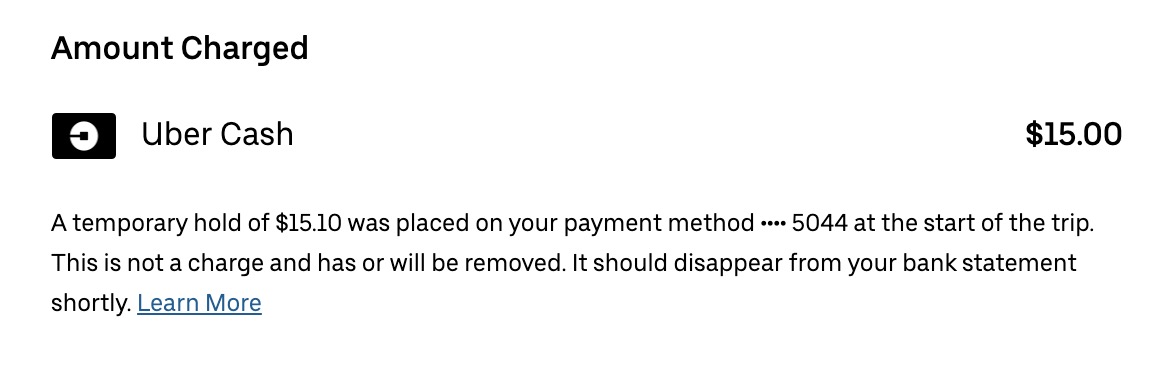
Besides banks, Uber Eats seems to have a mechanism somewhat similar to Small Balance Credit. I order Uber Eats every month, and since the AMEX Platinum gives a monthly $15-20 Uber Credit, it is hard to make the order total land at exactly $15. Sometimes when the total goes over, Uber Eats will automatically waive the excess. The exact cutoff is hard to pin down, but in my experience anything under 0.5 will often be waived. In the example below, the extra $0.1 was waived by Uber Eats. Feel free to share any interesting DP like this.
Ways to Use Small Balance Waivers
We do not recommend going out of your way to game Small Balance Credit. The amounts are tiny, and it is not worth spending much effort on. But trying it once in a while can still be fun. There are lots of ways to pair with Small Balance Credit, mainly by making very small credit card purchases. If you have nothing else to do, these tiny payments can also help put a little activity on your sock drawer cards. A few examples are listed below (note that final charges may include tax):
- Low-cost items with free shipping on eBay
- Wikipedia donations, starting at $1.0
- There are quite a few $0.99 apps on iTunes
- Prepayments for certain phone, electricity, or broadband bills
- Suica card, with a minimum of 1 yen, which converts to about 1 cent, with FTF (for such a tiny amount, effectively close to 0)
- Wechat can also go as low as RMB 0.01, which converts to about 1 cent. There are not many payment entry points, but you can explore on your own. A normal RMB 10 mobile top-up is also under $2, with FTF (for such a small amount, effectively close to 0). If you have JD Plus, there are still quite a few low-cost items with free shipping.
- WeChat Out payment, which needs to be paired with iTunes, starting at $0.99. WeChat Out is actually quite useful.
- Taobao and Tmall: strictly speaking, Taobao purchases no longer have FTF now, but Taobao does charge a 3% service fee. For very small purchases, that can basically be ignored.
Besides making tiny purchases, you can also consider intentionally underpaying a little before the statement closes, leaving a $0.99 or $1.99 balance so it gets wiped out when the statement generates. Of course, pay close attention here: this means paying early before the statement closes. If the balance is already on a posted statement, then you need to pay it in full. Even a very small remaining amount can generate interest.
Examples of Statement Adjustments
Below are several recent test results:
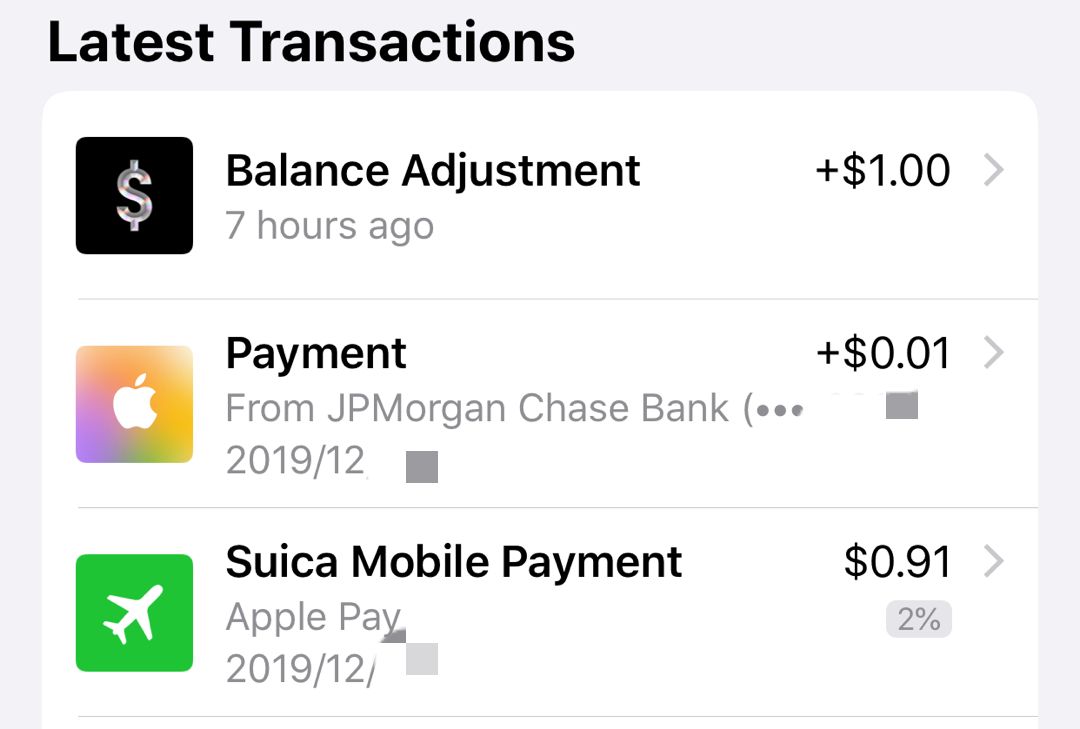
- Apple Card: $1.0 or less, shown on the statement as Balance Adjustment
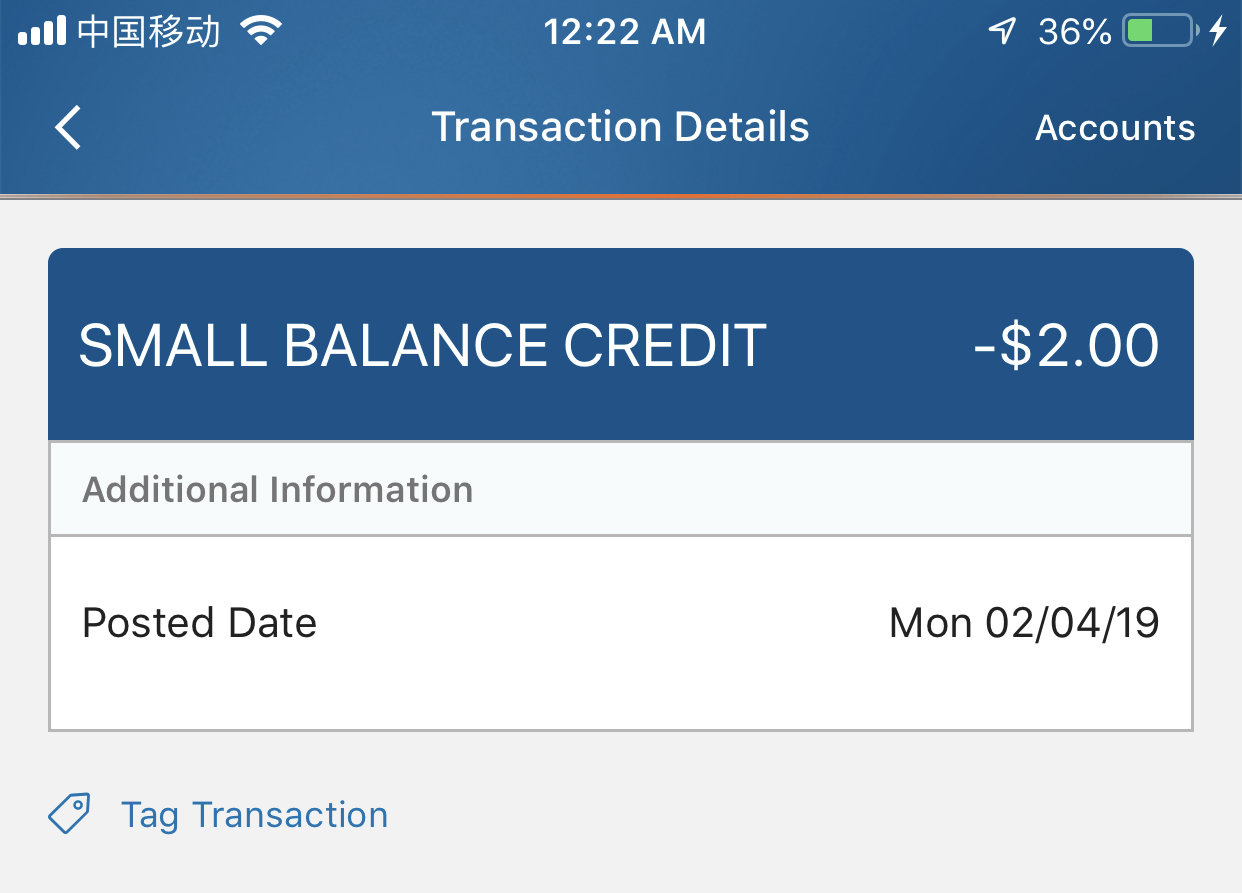
- Discover it: $2.0 or less, shown on the statement as Small Balance Credit
- Barclaycard: $0.99 or less, shown on the statement as Balance Adjustment
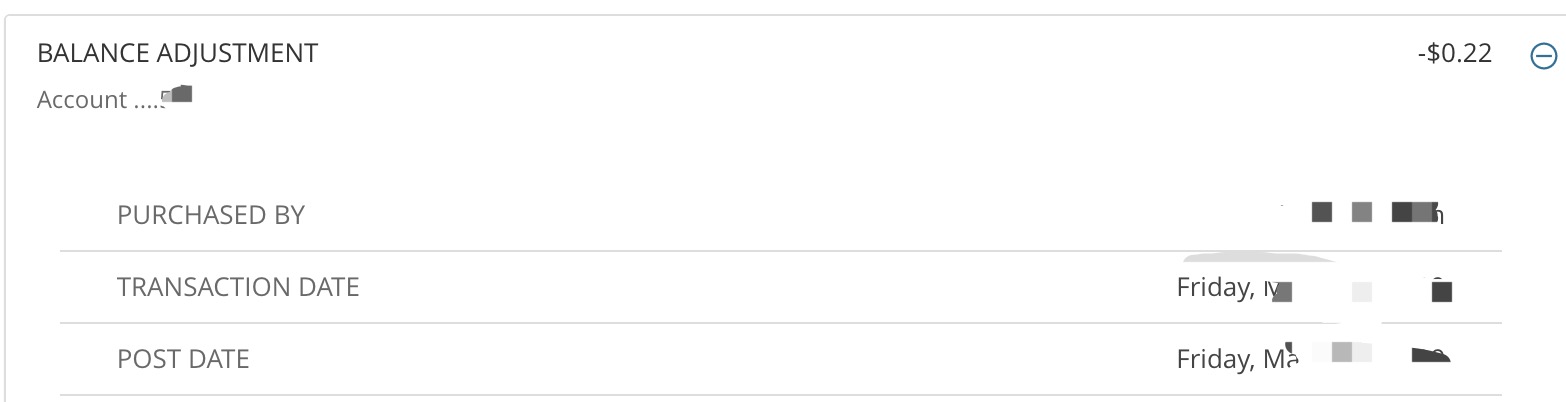
- US Bank: $0.99 or less, shown on the statement as Credit Adjustment

- AMEX Delta